In most states, traffic school doesn’t erase a ticket from your driving record. What it can do is lessen the impact. Depending on where you live, completing an approved course may keep points off your license, hide the violation from public view, or qualify you for ticket dismissal.
Each state sets its own rules, and those rules also determine whether your insurance carrier sees the violation.
For example, in California, traffic school “masks” one point from your record so insurers can’t view it. In Nevada, course completion reduces your point count, but the violation can still be visible to insurance providers. Some insurers in this state may offer discounts for taking the course, while others will factor the violation into your rate.
So, does traffic school remove a ticket from your record? The short answer is no, but the outcome is still worth pursuing—and it largely comes down to your state’s laws.
How traffic school affects your record, state by state
Seeing your ticket still listed on your record after finishing traffic school can be frustrating, but that doesn’t mean it was a wasted effort. Even if the citation remains visible, it may not affect your driving record or insurance costs. And, depending on the state, it may be removed after a few years.
That said, here’s what to expect after completing traffic school in California, Virginia, Texas, Nevada, and Florida:
| How Traffic School Affects Your Record, State by State | ||||
|---|---|---|---|---|
| State | Court Record | Driving Record | Can Auto Insurers See Your Ticket? | Time on Your DMV Record* |
| California | The ticket remains on your court record. No dismissal through traffic school. | One point is masked from your driving record after completing traffic school with a DMV-approved provider* like Best Online Traffic School. | No, auto insurers can’t see the masked point. The violation remains visible only to courts and law enforcement. | One-point violations (the only ones eligible for traffic school) stay on your DMV record for 36 months. |
| Virginia | The ticket remains on your court record. In some counties, judges may dismiss minor violations after traffic school completion. Check with your court before enrolling. | The conviction remains on your driving record. However, completing a Driver Improvement Clinic can add up to five safe driving points to your record, offsetting demerit points. | Yes, the violation remains visible to insurers. Some insurance carriers offer discounts for voluntarily completing the course.** |
|
| Texas | Depending on the offense, the court may dismiss your ticket after you complete a defensive driving course. To qualify, the course must be provided by a TDLR-approved school,*** such as Traffic Safety Institute. | If dismissed, the conviction doesn’t appear on your driving record. | Dismissed tickets aren’t reported to insurers. | Since the ticket is dismissed, it’s not listed as a conviction on your driving record. A record of the citation and its dismissal may remain in the court’s internal records or law enforcement databases. |
| Nevada | The violation stays on your court record after traffic school completion. | Traffic school removes 3 demerit points from your DMV record if you already have 3–11 points on your record and you take the course through a Nevada DMV-approved provider like Traffic Safety Institute. | The violation is still visible to insurers. Some may offer a discount for course completion. | Demerit points are automatically removed 12 months after the conviction date, but the conviction itself remains on your permanent driving record. |
| Florida | Every traffic ticket issued in Florida creates a court case, and that case remains in the Clerk of Court’s system even if adjudication is withheld.**** | Completing traffic school removes all points associated with a minor moving violation from your driving record. In Florida, traffic school is called a Basic Driver Improvement (BDI) course and must be completed through a state-approved provider, such as Traffic Safety Institute.***** | Following course completion, the citation record is still visible to insurers, but they can’t raise your premiums when adjudication is withheld and no points are added to your record. Some insurance carriers will reduce your premium by up to 15% for voluntarily completing a state-approved BDI course, even if it’s not tied to a traffic ticket. | Minor traffic violations remain on your record for 3–5 years. |
* DMV — Department of Motor Vehicles ** You can receive safe driving points or an insurance discount, not both. *** TDLR — Texas Department of Licensing and Regulation **** When adjudication is withheld, it means the court has decided not to formally convict you of the traffic violation. ***** The school must be approved by the Florida Department of Highway Safety and Motor Vehicles (FLHSMV). | ||||
- Demerit points remain for two years from the conviction date.
- The conviction stays on your record for 3–11 years, depending on severity.
* DMV — Department of Motor Vehicles
** You can receive safe driving points or an insurance discount, not both.
*** TDLR — Texas Department of Licensing and Regulation
**** When adjudication is withheld, it means the court has decided not to formally convict you of the traffic violation.
***** The school must be approved by the Florida Department of Highway Safety and Motor Vehicles (FLHSMV).
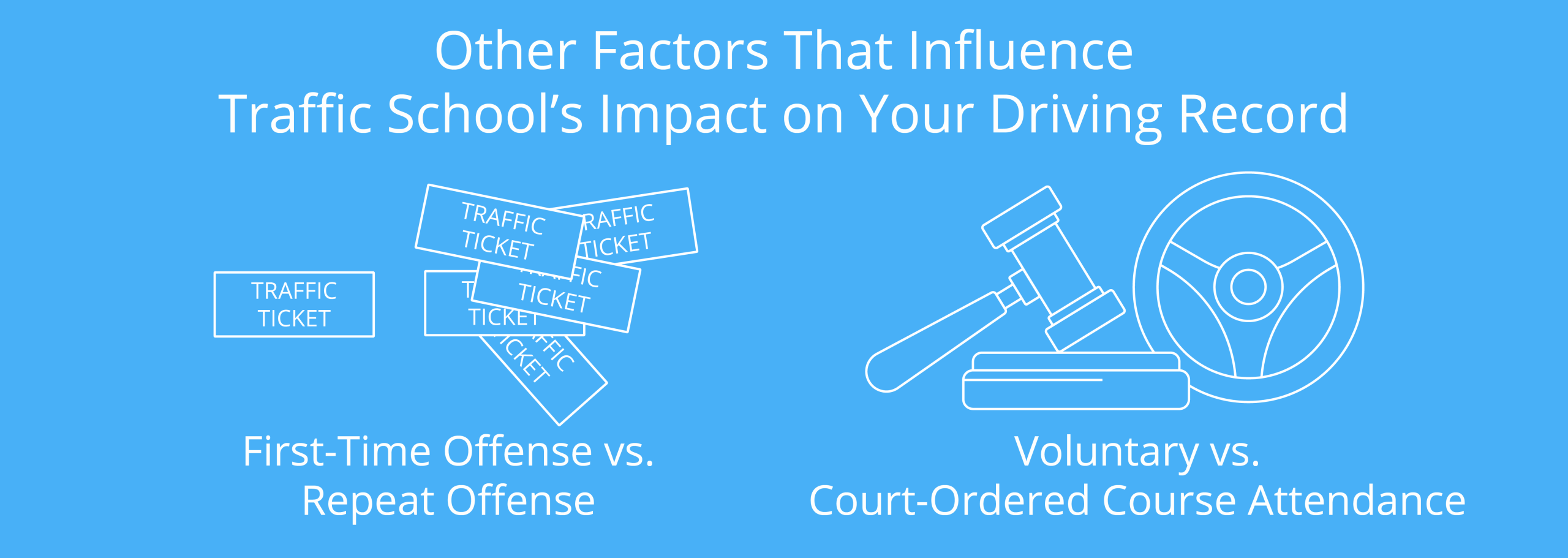
The impact of traffic school on your record also depends on individual factors, such as whether you’re taking the course voluntarily or under a court order.
For instance, Nevada drivers may have a citation dismissed if they complete traffic school as part of a plea bargain. And, in most states, first-time offenders typically have more options available to them than repeat violators, who may not qualify for ticket dismissal or insurance discounts after finishing the course.
Should you take traffic school or just pay the ticket?
While it can be tempting to just pay the fine and move on, that convenience often comes at a price: higher insurance premiums, points on your record, or both.
Traffic school is often more cost-effective in the long run. Not only does it allow you to keep points off your license or dismiss your ticket, but it may also prevent insurance increases. And if your point count is already high, it could help you avoid license suspension.
Say you’re caught speeding 20 miles per hour over the limit in Marin County, California. Here’s what paying the ticket actually costs:
- Base fine: $70
- Penalty assessments and surcharges: $217
- Court fees: about $76
- Insurance rate increase: around 39% for three consecutive years
The base fine is the smallest part of the bill. The real hit comes from the $293 in administrative and court fees and, more significantly, your insurance.
If you’re currently paying $3,000 a year for full coverage, a single speeding ticket bumps that to around $4,170 for three years in a row. That’s an extra $3,510 before you’ve even thought about the demerit point on your record.
Total cost of just paying the ticket: $3,873, plus one point on your license.
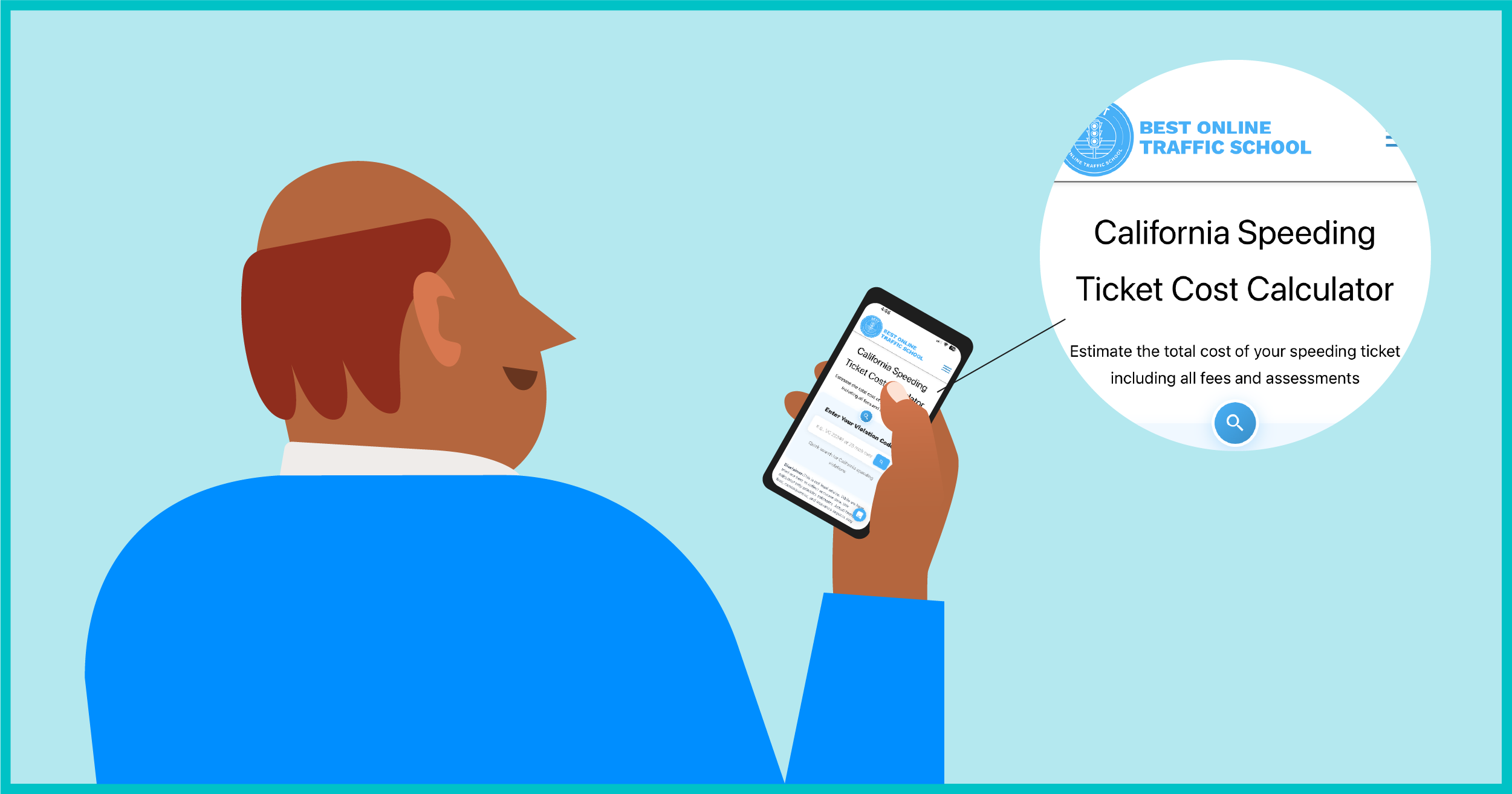
Want a more accurate estimate? Use this speeding ticket cost calculator to run the math for your specific case.
Now, let’s assume you complete traffic school. While you still have to pay the base fine, penalty fees, and a traffic school administrative fee of $49 to $79, your insurance rate stays the same because the ticket doesn’t appear on your public record.
Total savings: ~$3,510 over three years—and no points added to your license.
As for the cost of traffic school, expect to pay up to $70, depending on the provider and other factors.
Traffic Safety Institute, for example, charges an all-inclusive flat fee of $19.99 to $49.99, depending on the course you enroll in. Our low fee covers course materials and helpful extras such as:
- Certificate submission to the DMV (where applicable)
- Unlimited course retakes and exam attempts
- Live chat support around the clock
That’s a small price compared to the thousands of dollars a speeding ticket can add to your premiums over the next three years. Traffic school essentially pays for itself.
Are you eligible for traffic school?
Traffic school is generally available to drivers cited for minor moving violations, such as running a red light or failure to yield. Eligibility requirements vary by state, but here’s who typically qualifies in Florida, Nevada, Texas, and Virginia:
| State | Basic Eligibility Criteria | How Often Can You Take Traffic School? | Disqualifying Offenses |
|---|---|---|---|
| California |
| Once every 18 months. |
|
| Virginia |
|
|
Unlike most other states, Virginia doesn’t prohibit drivers charged with serious offenses from attending traffic school. However, the benefits are mutually exclusive:
|
| Texas |
| Once every 12 months. |
|
| Nevada |
| Once every 12 months. |
|
| Florida |
| Once every 12 months and no more than five to eight times within your lifetime (depending on the county). |
|
* If you’re charged with reckless driving or another major offense, the court may order traffic school as part of your sentence. In such cases, you won’t qualify for point reduction, but completing the course may help reduce charges or penalties. ** Per Section 316.306(4)(a) of the Florida Statutes, drivers cited for texting in a school or work zone for the first time can take a Wireless Communications Device Course to have the penalties waived. | |||
- You plead guilty to the charge
- Valid non-commercial driver’s license
- Cited for an infraction
- Violation didn’t occur in a commercial vehicle
- No alcohol or drugs involved
- DUI or alcohol-related offenses
- Reckless driving or any two-point violation
- Speeding 25+ mph over the limit
- Violations requiring mandatory court appearance
- Non-moving violations (e.g., illegal parking)
- Driving with suspended or expired license
- Driving without a license
- Valid non-commercial driver’s license
- Ordered by court or Virginia DMV, or
- Voluntary enrollment for safe driving points or demerit reduction, or
- Qualifying for an insurance discount
- Once every 24 months for voluntary enrollment.
- No frequency restriction for court- or DMV-ordered attendance.
- Valid non-commercial driver’s license
- Plead guilty or no contest
- Cited for a minor moving violation
- No alcohol or drugs involved
- Violation not in a construction or school zone
- Not currently enrolled for another offense
- Traffic misdemeanors or felonies, including DUIs/DWIs
- Speeding 25+ mph over the limit
- Driving 95 mph or more
- Driving without insurance
- Leaving the scene of an accident
- Violations in a construction zone with workers present
- Passing a stopped school bus
- Valid non-commercial driver’s license
- Cited for a minor violation carrying 1–4 points
- Already have 3–11 points on your record
- Court-ordered attendance
- No alcohol or drugs involved
- No accident with injuries
- Offense not in a school zone
- DUIs or DWIs
- Reckless driving or other serious offenses*
- Violations resulting in injury or death
- Violations requiring mandatory court appearance
- Driving without valid license or insurance
- Having pending traffic violations
- Cited for an infraction
- Valid non-commercial driver’s license
- Plead guilty or no contest
- No alcohol or drugs involved
- Not cited for texting in a school or work zone**
- Criminal moving violations
- Texting in a school or work zone
- Exceeding the speed limit by 30+ mph
- Any citation related to a DUI
* If you’re charged with reckless driving or another major offense, the court may order traffic school as part of your sentence. In such cases, you won’t qualify for point reduction, but completing the course may help reduce charges or penalties.
** Per Section 316.306(4)(a) of the Florida Statutes, drivers cited for texting in a school or work zone for the first time can take a Wireless Communications Device Course to have the penalties waived.
Note that traffic school eligibility is nuanced, and the rules vary by state and county. Always check with the clerk of court before enrolling.
In Florida, for instance, drivers cited for a wireless communications device violation, such as texting behind the wheel, aren’t eligible for the Basic Driver Improvement course. To qualify, they must have previously completed a Florida Wireless Communications Device course and later received a subsequent citation for the same type of offense.
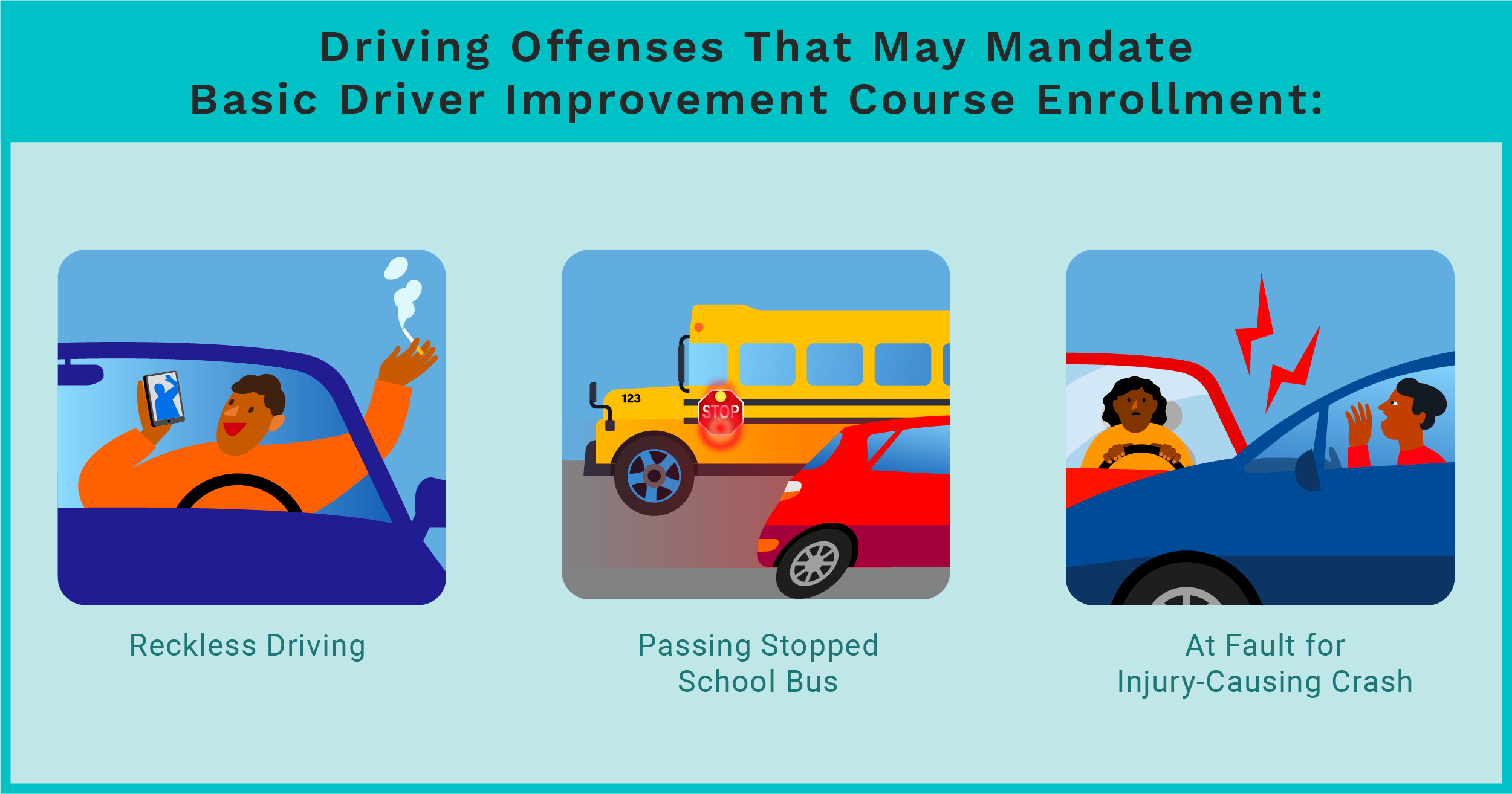
There are also instances where taking a BDI course is mandatory. Some examples include reckless driving, passing a school bus, or being found at fault for a crash resulting in bodily injury.
As for commercial drivers, federal law under 49 CFR § 384.226 prohibits states from allowing commercial driver’s license (CDL) holders to complete traffic school to mask a violation from their driving records. This restriction applies regardless of whether the offense occurred in a commercial or personal vehicle.
Will your insurance company see the ticket?
In most cases, insurance companies can’t see your ticket once you’ve completed traffic school. Even when they have access to this information, state law may prevent them from raising your rates.
Here’s how it breaks down in each of these five states:
- California: Traffic school can mask one point from your record, so insurers can’t see the ticket and won’t raise your rates.
- Virginia: Auto insurers can still see your ticket, but traffic school may help offset its impact through added safe‑driving points or an insurance discount.
- Texas: Dismissed tickets don’t appear on your driving record.
- Nevada: The violation remains visible to insurers, though some may offer discounts.
- Florida: Electing the BDI course results in adjudication being withheld, meaning no conviction is formally entered and no points are assessed. Insurers can’t raise your premium for such violations.
Some insurance companies in Nevada, Florida, and other states offer discounts for voluntarily completing traffic school.
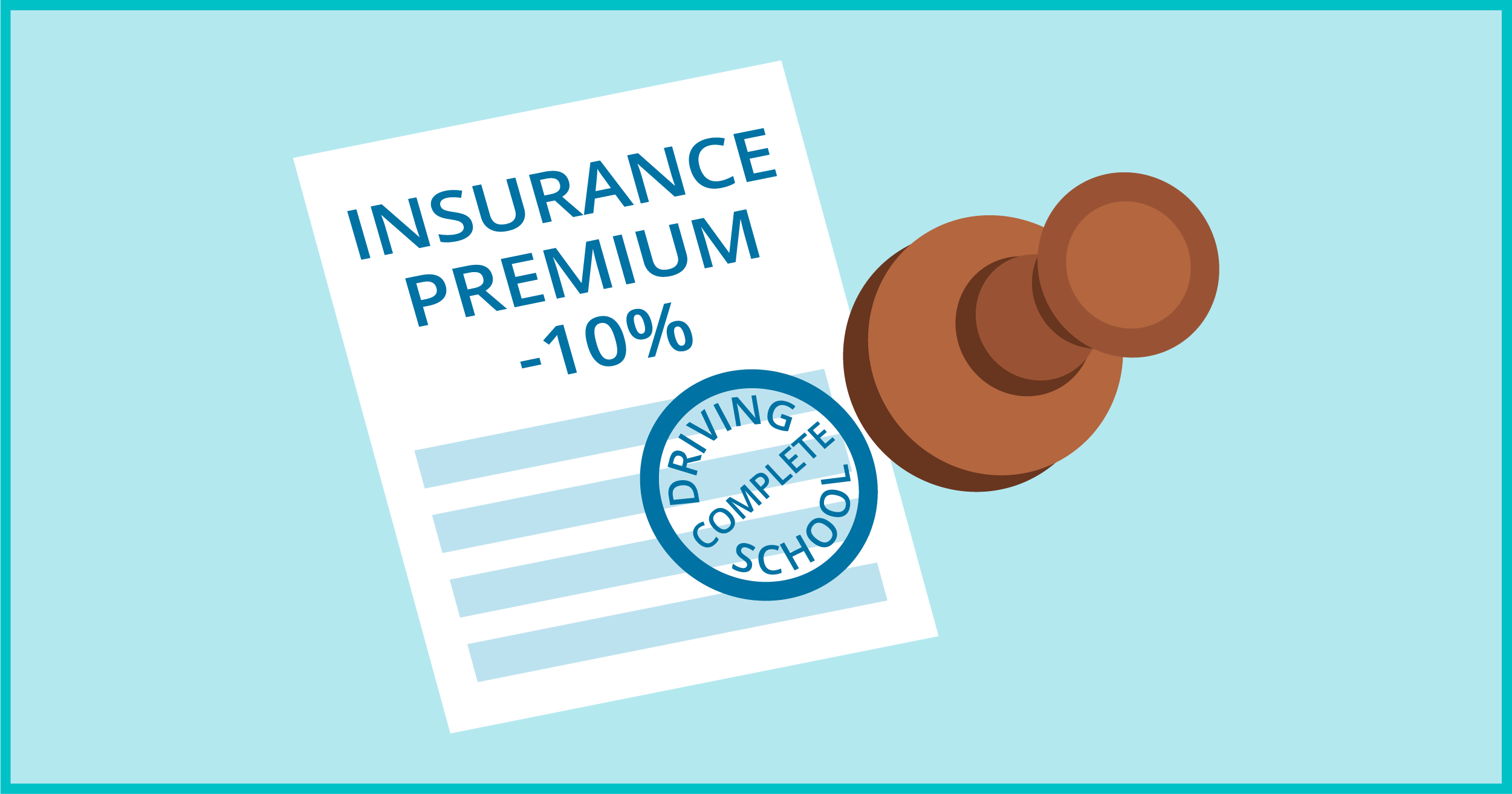
For example, Nevada drivers who voluntarily take a DMV-approved course may qualify for reduced premiums. In Florida, voluntary completion of a BDI course may reduce premiums by 5% to 15%.
Similarly, Texas residents who complete an approved defensive driving course can get an insurance discount of up to 10%. Even if you haven’t received a ticket, taking the course voluntarily can bring your premiums down.
What to do if traffic school didn’t seem to work
Have you finished traffic school, but the ticket still appears on your record? Or maybe your insurance rate went up anyway? This can be frustrating, but the fix is often simpler than it seems.
Start by checking your driving record with the DMV. Course completions aren’t always reported right away, and it can take 30 to 60 days for your record to update.
If enough time has passed, contact the court to confirm your completion was received and that adjudication was withheld. Sometimes paperwork falls through the cracks.
If your insurance rate increased despite finishing the course, call your insurer and reference the adjudication. Ask whether a conviction was reported and, if so, request a review of your file.
Most of the time these issues are purely administrative, and a couple of phone calls are all it takes to sort things out.
Traffic school can protect your record—and your wallet
While traffic school won’t fully remove a ticket from your record, it can still lower your point count, dismiss a citation, and/or help prevent insurance increases.
The first step is choosing a trusted provider like Traffic Safety Institute, which offers state-approved courses in Virginia, Texas, Florida, and Nevada. Our courses are 100% online and accessible from any device, so you can work through the material at your own pace.
For California traffic school, see our partner school, Best Online Traffic School, which is the only brand under which we offer that course.
Here’s what you get after registering with TSI:
✅ Easy-to-follow lessons built by real educators
✅ Unlimited course retakes
✅ Practice tests and quizzes
✅ Free audio read-along
✅ Multi-device compatibility
✅ Save-and-resume feature
✅ Instant digital certificate
✅ Electronic submission to the DMV
✅ 24/7 live chat support in 100+ languages
Our flat fee covers everything listed above. At checkout, you may see optional upgrades like Peace of Mind follow-up or notarization services when needed. They’re pre‑selected to save you time, but you can easily deselect anything you don’t need.
The best part? You can take most of our courses for free and pay only after you pass. One exception is the Virginia Driver Improvement Clinic, which requires upfront payment.
We’re proud to be one of the few traffic schools with a rating of 4.92 across review sites. Students find our courses engaging, helpful, and stress-free, allowing them to focus on learning and passing the final exam.
Don’t wait until it’s too late. Start traffic school today to protect both your driving record and your wallet.
FAQs about traffic school and your driving record
Need more information about traffic school and its impact on your driving record? Below are the answers to some questions you may have:
Can I take traffic school if I got a ticket in another state?
It depends on the states involved. Generally, you’ll need to take a course approved by the state that issued the ticket, not your home state. Check with the issuing court and your home state’s DMV before enrolling.
What happens if I miss the court’s deadline to complete traffic school?
If you don’t finish traffic school on time, the conviction goes on your record. That means demerit points, insurance rate hikes, or both. If you’ve already accumulated too many points, your license could be suspended.
In such cases, contact the court before your due date. Depending on state laws and the court’s policies, you may be able to get an extension.
Can traffic school help me avoid a license suspension?
Yes. Most states suspend your license once you accumulate too many points within a set period. Depending on where you live, completing traffic school can reduce your point total and help you avoid license suspension. If you’re already close to that limit, this is one of the best reasons to enroll.
For example, the Nevada DMV will automatically suspend your license for six months if you accrue 12 or more points within a 12‑month period. But if you have between three and 11 points, you can complete a state‑approved traffic safety course—like the one offered by TSI—to remove three points from your record.
Do I need to notify my insurance company after completing traffic school?
The answer depends on why you took the course. If you completed it to dismiss a ticket or mask a point, you typically don’t need to notify your insurer.
If you took the course voluntarily to qualify for an insurance discount, you’ll have to submit your completion certificate to your provider. Check with them before enrolling to make sure you’re eligible for the discount.
Is there anything else I need to pay in addition to the traffic school fee?
Yes, in most cases. The course fee covers what you pay the traffic school provider, but you may also need to budget for:
• Your ticket fine: The fine amount is paid to the court, regardless of whether you complete traffic school.
• A court election or administrative fee: Some states, such as California, charge a traffic school administrative fee.
• Notarization: Nevada and a few other states require a notarized affidavit to approve traffic school completion. Traffic Safety Institute offers a notarization add-on so you don’t have to find a notary on your own.
All fees owed to the court or DMV are paid directly to those agencies, not to your course provider.